"The Open Data Delusion" at 10 years
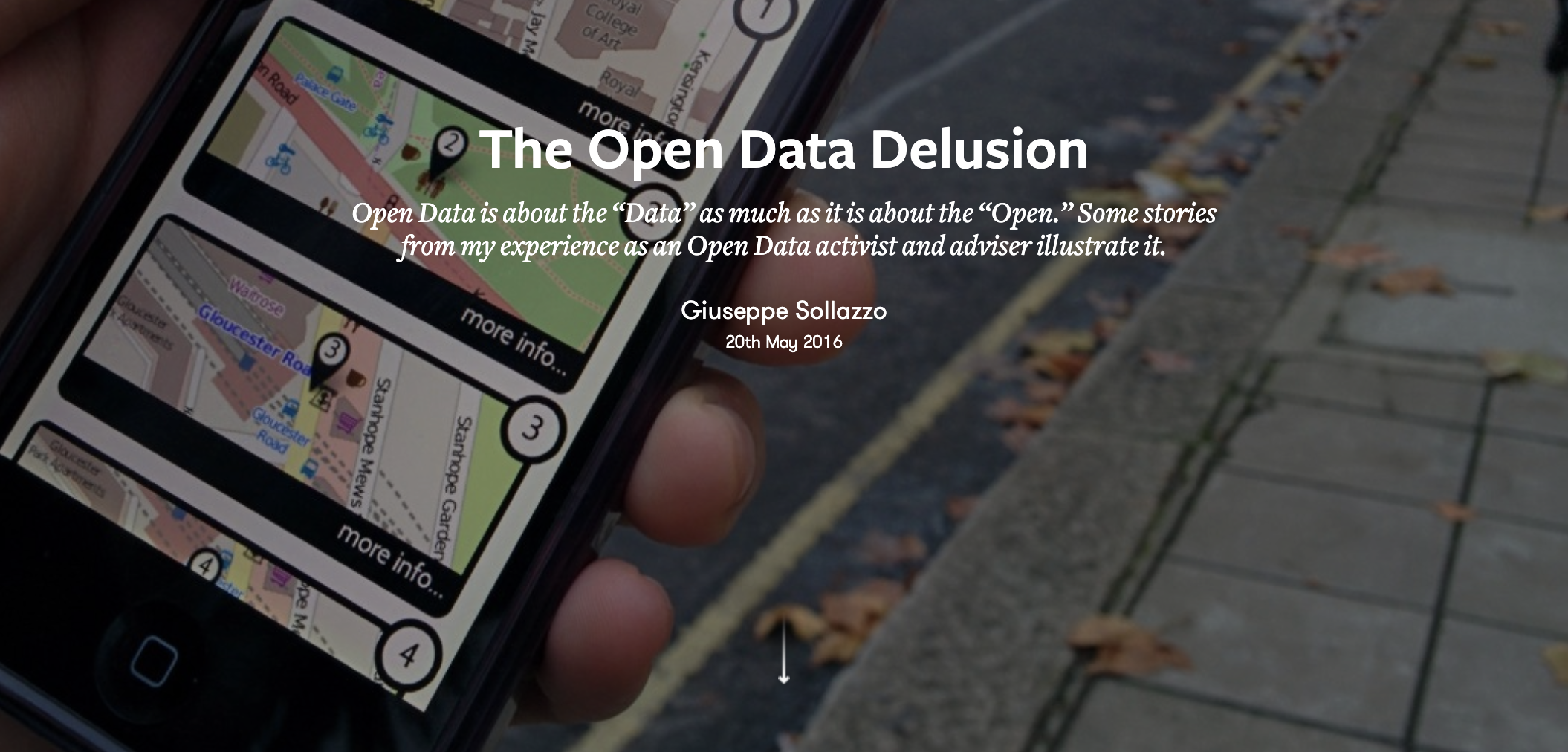
It’s been 10 years since I published an article called “The Open Data Delusion” on a now defunct news outlet called “Broken Toilets”. You can still read it on my own blog.
Of the many examples I mention, the Great British Public Toilet Map (ok, there’s a theme here) is still going strong. But it is maintained by a spin out, rather than a public authority: the system never absorbed it, and Open Data still needs a lot of advocacy work to be extracted out of public systems.
In my article there was no doubt some naivety about how Open Data could be powerful to fix things in public service, despite my critical stance. I maintained that “Open Data is ultimately powerful when it represents a conversation between data experts inside the system and data users who access that system.” I talk about “the Open Data killer app.”
A lot of time has passed and the Open Data killer app never materialised. Well, in a way it did, but it’s not an app. The Open Data killer app is Artificial Intelligence. US federal agencies are deploying MCP servers so generative AI systems can query public datasets directly, while in the UK, the Government Digital Service published guidelines in January 2026 on how to make government datasets “AI-ready”. My argument that schemas, documentation, update frequency, and licensing, were much needed still holds true. But the demand for Open Data as a tool for humans never truly materialised until AI started to tap into it. The killer consumer of Open Data is a machine, which makes me smile nostalgically when I read again that line about a “conversation between data experts inside the system and data users who access that system”.
We’ve also spent a lot of time counting dataset released rather than asking what they were empowering and what guarantees they had to comply with. News in the media of various Governments stopping the publication of open data and, in some cases, withdrawing existing datasets are concerning. But the good news is that nobody has still managed to fully block the publication of data and, especially in Western countries, any stop to publication has often been reverted. But the process of open data publication is still not part of wider information rights. It never truly caught on. “Number of datasets” was not just a bad success metric based on vanity, it was a metric that treated open data as a stock rather than a commitment. My 2016 self worried the UK’s league-table position was hollow; the 2026 version of that worry is that league tables measure something that can be deleted on a Tuesday.
In 2016 I also worried that the shift from Open Data and Transparency to Data Government Programmes would mean a retreat from public engagement; but also was a promising sign that Governments, and particularly the UK Government, were treating data as something to build strong foundations on, especially in operations. I now work in Government Data, and my move was motivated by optimism that this was a good thing. I still believe this to hold true, and the operational data government I half-hoped for is genuinely being built, and I’m part of this alongside many others who started as Open Data enthusiasts in the 2010s. Engineering has also improved, and we’re also seeing good work to build a National Data Library.
There’s also a sense that some of the energy of the “Open” data days has been lost, and I believe this to be part of a wider reduction of mutual trust in Western societies. Clearly, I think this is all eminently fixable if we focus on real user needs and data (and AI) as tools to deliver them, which is very much the driving force in my current day job. History moves in cycles, and I do see strong signs that the appreciation for openness is getting stronger in the age of AI.